
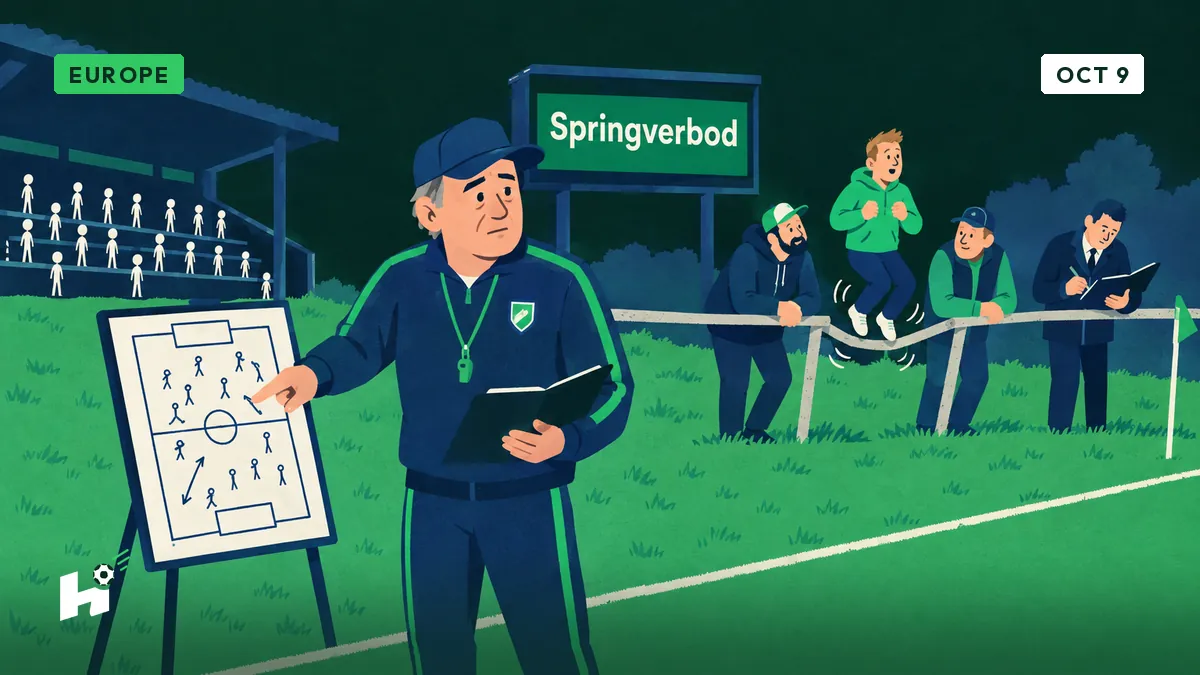
Tactically, VfL Bochum announced on Wednesday a “springverbod”. A jumping ban. For its home supporters, from the following weekend, and until 2028 at least. Cheering stays allowed. What is banned is the rhythmic jumping of the whole crowd.
I read that twice, folder open on my knees. According to the club, a firm of engineers carried out a study and found that the Ostkurve at the Ruhrstadion shakes heavily when everyone jumps together. They call it the “trampoline effect”. Where I am, we call that pitch 2. It doesn’t shake, it slopes. But I recognise the principle: a structure with its own opinion on how you behave on it.
What interests me is how they manage the collective. If the supporters don’t respect the ban, the club threatens to close the whole stand. Up to 10,000 seats. That’s a clear message in the dressing room. When I threaten to close something, it’s the bar, and the bar funds the transfer budget, so I never close it. They know that.
The club plans to strengthen the stand, but not before 2028. Then the ban will be lifted. In 2016, FC Magdeburg went through the same thing: three years without jumping for its hardcore fans, until the stand was reinforced for millions of euros. Three years. My UEFA B licence has been in progress since 2011, I know what it’s like to wait for a structure.
Three years without jumping, that’s a disgrace. I’m weighing my words. Still, if they sing well, there are positives.
I applied it to my side in the third provincial division (Belgium’s Sunday amateur leagues). We don’t have a stand, we have a railing and four dads. When we score, one of them jumps. One is fine, mind you. The railing has held since 1987.
Sunday, at three o’clock, I decided one thing anyway: no more group celebrations on the touchline on the slope side. We’ll celebrate in the centre circle, on the flat. The club delegate wrote that in his folder, under “structural measures”.
It’s true, we checked: HLN.