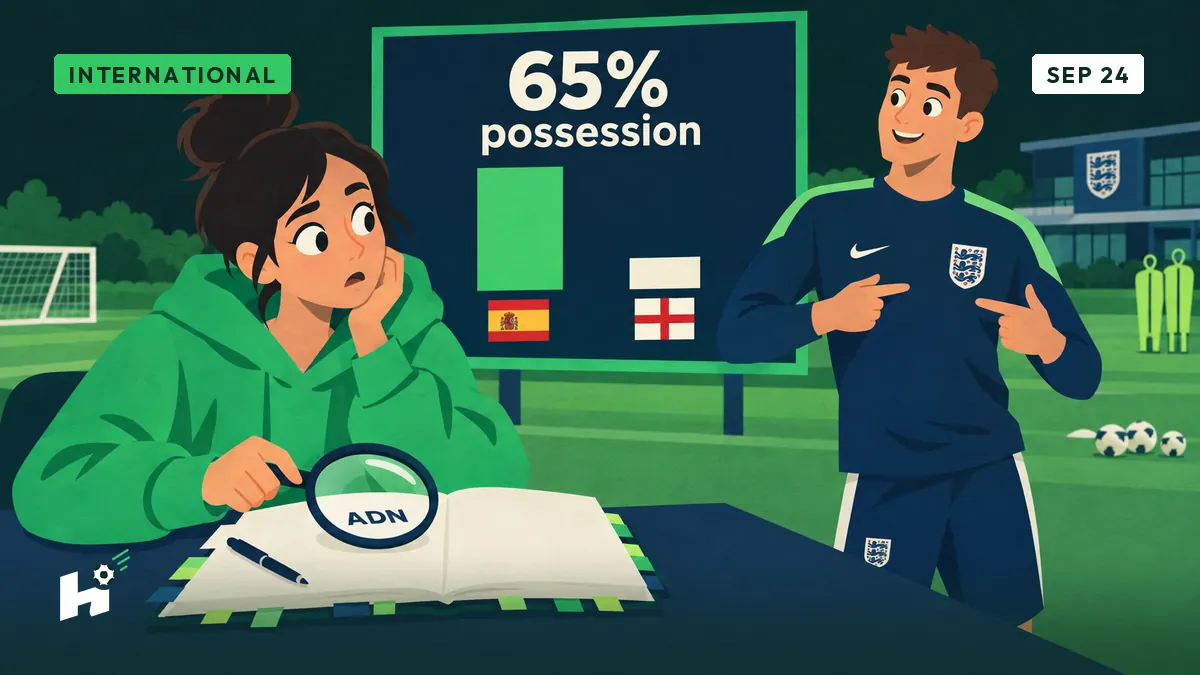
Anthony Gordon said, at St George’s Park, that controlling a match “is not in the English DNA.” The forward, who joined Barcelona from Newcastle this summer for £69.3m, was speaking before Saturday’s game against Spain, England’s first gathering since the World Cup.
He added: “We can’t keep looking at other countries and trying to be like them, because we’re not them – we’re English and we have our own strengths which they don’t have, so maybe we start playing the way we’re good at,” he told the BBC. He also described the semi-final defeat as a scar that “doesn’t have to be a negative one because it might lead us to victory in the next tournaments.”
Louise got her notebook out. She checked “DNA” first in the glossary she’s kept since her first day covering football. Nothing there. So she asked three different people what exactly was in this English DNA, besides not controlling the ball.
I was told “courage”, “long balls” and “the rain”. None of the three answers is a chromosome. I checked, and actually nobody knows what’s really in there. Anyway, I still have a lot to learn.
Silly question, but if English DNA means not controlling the ball, how come Gordon himself, a starter in five matches during the tournament with four assists, put England ahead against Argentina before being substituted seventeen minutes later? Manager Thomas Tuchel then switched to a back five, a decision criticised ever since. Enzo Fernandez equalised, then Lautaro Martinez won it for Argentina in stoppage time. England then beat France 6-4 for third place, their best World Cup result since 1966.
Spain, for their part, were crowned champions after dominating Argentina with 65% possession, limiting Lionel Messi’s side to two shots off target in 120 minutes. Louise wrote in the margin: “Controlling the ball actually seems to work.” She also added that England have lost two consecutive European Championship finals and were knocked out by France, then Argentina, in the last two World Cups, which, in her view, might deserve a second chromosome to look for.
It’s true, we checked: BBC Sport.