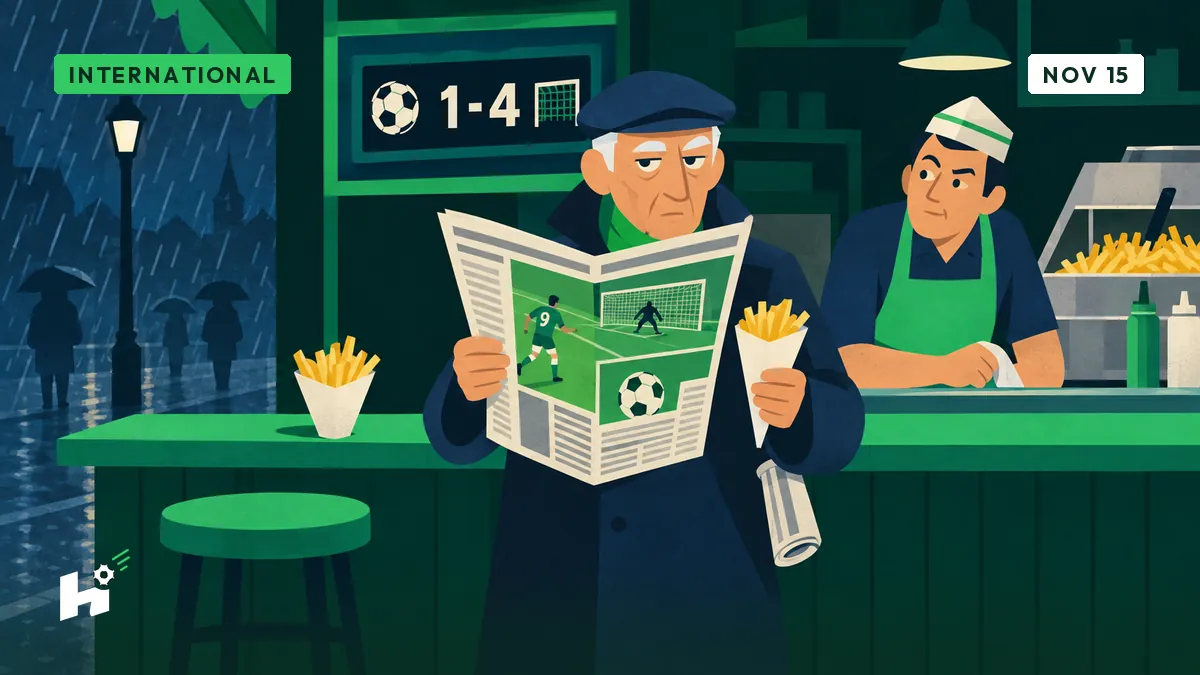
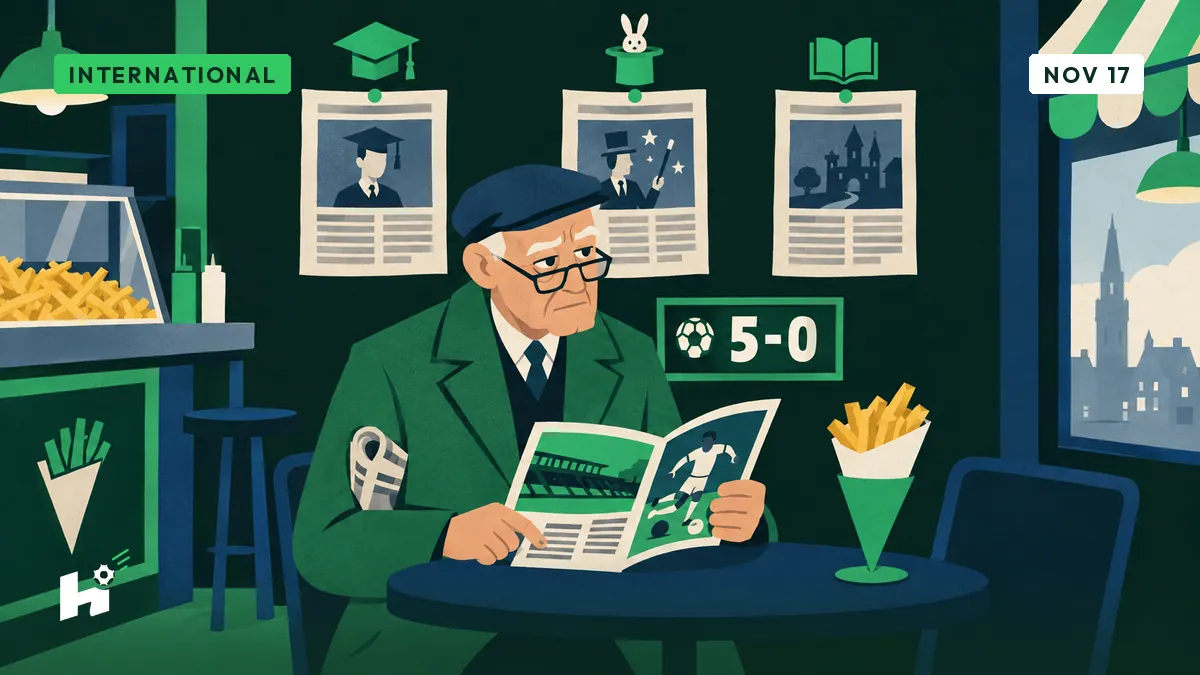
Germany beat the Netherlands 5-0, in Berlin. I read the roundup of the papers on NOS, the Dutch broadcaster, with my reading glasses, at the chip shop.
Bild wrote, according to NOS, that it was a masterclass by Klopp, the magic of Wirtz, a fairy tale for Scherhant. Three genres for one match: a lesson, a conjuring trick and a children’s story. I’m not criticising. I’m comparing. In 1980, they wrote that Germany had won, and the reader worked out alone that it was good.
On the other side, de Volkskrant wrote: “On Friday a side brushing up against the European elite, on Monday a disorganised mess, without passion or discipline. Without class too, without team cohesion.” That’s a lot of withouts. According to Sporza, the Flemish public broadcaster, Xavi Hernández’s team could nonetheless have secured first place in the group, and had just beaten Greece 7-0. De Telegraaf writes that after a poor first half, it imploded completely after the break.
I note that the press does not know about half-time. It goes from fairy tale to implosion without visiting the dressing room.
A masterclass is historic. I’m weighing my words.
According to AS, Wirtz scored the 2-0, then Schlotterbeck, Wirtz again and Gruda scored in the second half. Süddeutsche Zeitung presents Scherhant and Gruda, flourishing under Klopp, as the driving force of the win. Flourishing wingers. In my day, a winger was on the right or on the left. He didn’t flourish. He was on the left.
According to NOS, Germany had been knocked out by Paraguay at the World Cup, and Bild speaks of a hangover. So it took a hangover to reach the fairy tale. I know that road. My weekly, for its part, would have put it in one line.
It’s true, we checked: NOS.