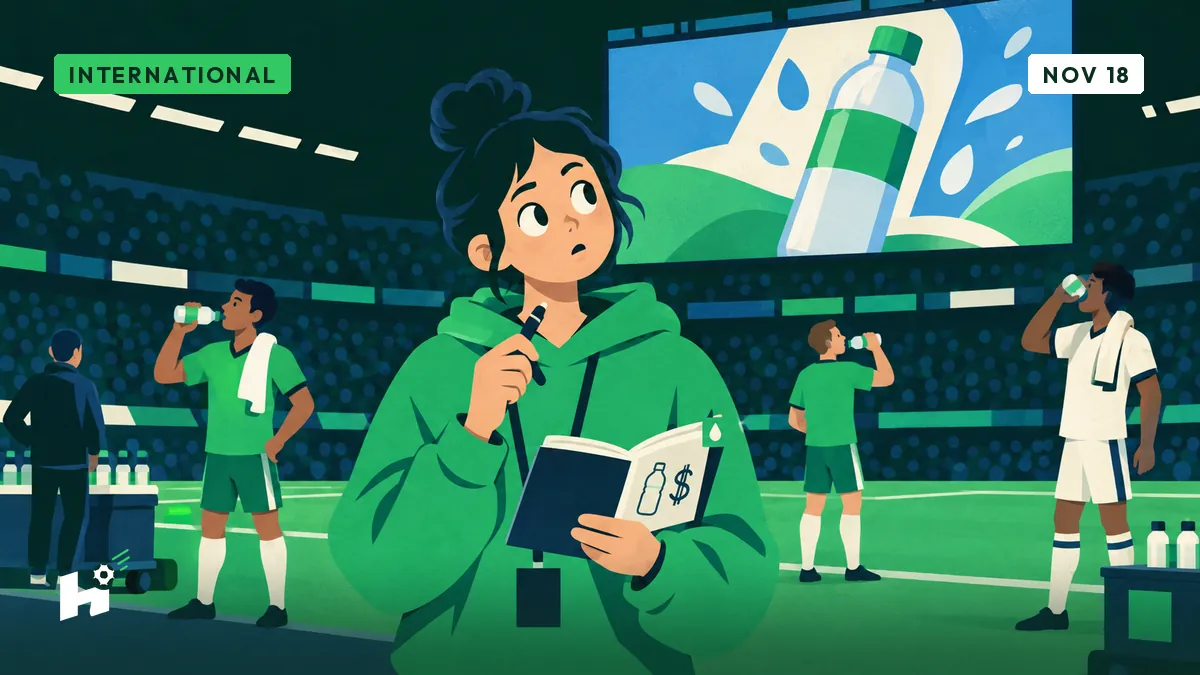
Silly question, but how much does a break to drink water earn? I looked it up. According to the Hollywood Reporter, cited by the Guardian, the hydration breaks at the 2026 World Cup generated between $2 million and $9 million in advertising revenue per match. I read it twice. I opened a new tab in my notebook: “Water”.
Let me start again, because I come from basketball, and in basketball you know who calls a timeout. At last summer’s World Cup, for the first time, a three-minute break was introduced in the middle of each half, across all 104 matches, in the interest of player welfare. Thirty-one of those matches were played in air-conditioned stadiums. I noted that in the margin, with a small question mark.
Now, according to the Guardian, Fifa’s tender documents for the 2030 World Cup TV rights allow broadcasters to sell advertising during these breaks. That strongly suggests they will be kept. Fifa, for its part, says it hasn’t decided yet. Fifa sources told the Guardian the tenders were designed to cover every possible option. So there is advertising planned for a break that isn’t planned. I checked, and actually that’s possible.
There are also cooling breaks at UEFA: a stoppage of between 90 seconds and three minutes when the temperature on the pitch reaches 28°C. The documents refer to those too. Two kinds of break, two names, one sip.
I showed my notebook to Freddy at the newsroom café.
Three minutes in the middle of the half? That’s when the club delegate goes looking for the water bottles. If anyone wants to buy the space, the clubhouse bar is open.
Last figure in the tab: according to the analyst Guideline, Fox earned $835 million in advertising yield on the tournament, almost double the $485 million paid to Fifa for the rights. For the Women’s World Cup in Brazil, there will be no mandatory hydration breaks: it should be cooler there. Anyway, I still have a lot to learn.
It’s true, we checked: The Guardian.