
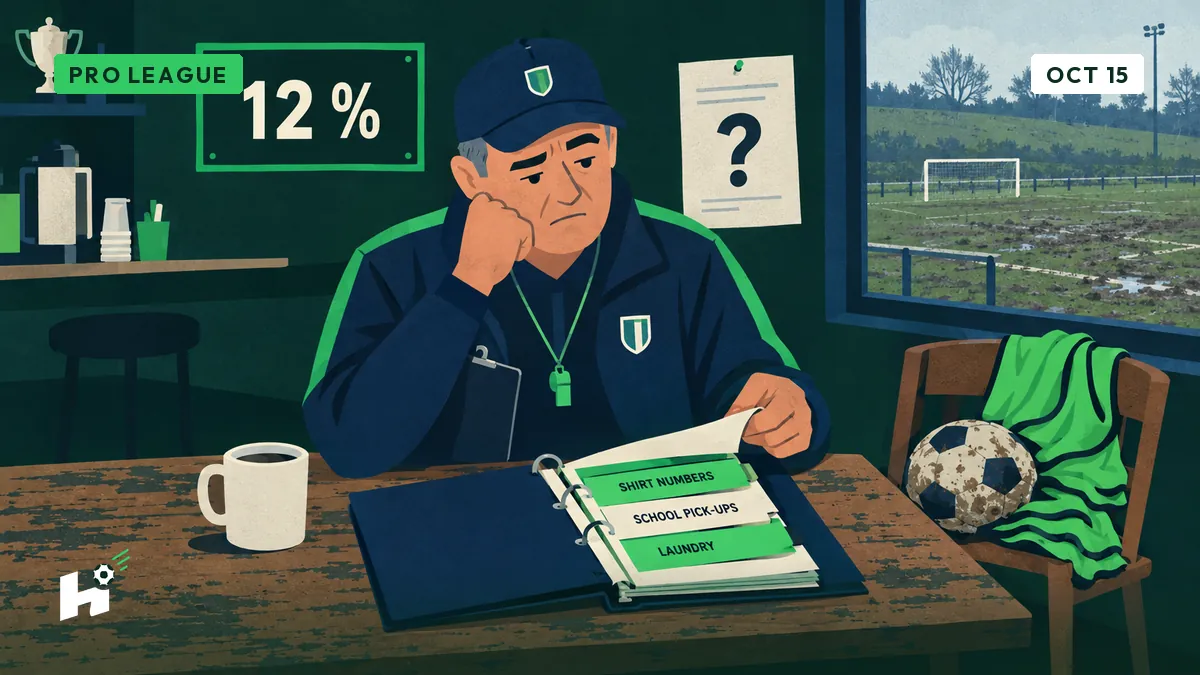
Tactically, that’s clever. Bruges won 3-4 at Inter, Tresoldi scored all three, and on top of that we learn he has a clause. According to Het Nieuwsblad, 12% of the capital gain on his next transfer. Not of the total fee, says VoetbalPrimeur: of what is left after the initial investment and certain costs.
I opened my team folder on the clubhouse bar table, next to a mug of coffee. I looked for the page with the clauses. There’s the page with the shirt numbers, the page with the kids to pick up at 5pm, and a page where the club delegate (the volunteer who handles the match-day paperwork) has written down who washes the kit. No clause.
The principle is pure teamwork. The player scores, his value goes up, his share goes up, the club wins too. Everyone pulls the same way. The intentions are aligned. I run that on Tuesday. When we’ve got eleven, that is.
Voetbalkrant and Walfoot did the sums: a departure for just under 40 million euros, nearly 30 million in capital gain, 3.6 million for him. Bruges paid 7.5 million euros to Hannover for him, according to them. Our last transfer was a ball and a set of bibs, paid for by the clubhouse bar. Capital gain: nil. The ball ended up in the stream behind pitch 2.
Apparently a similar arrangement is said to have existed for Ardon Jashari. So it’s a house method, like our 4-4-2.
“Silly question, but if your centre-forward had 12% of his own capital gain, how much would he owe you?”
I didn’t answer. I went to fetch the cards the delegate had forgotten.
What strikes me is the consistency: 69 games, 32 goals, nine assists according to VoetbalPrimeur, nine goals in eleven games this season according to Walfoot. A striker like that, I play up front, alone, and on a slope. A flat pitch away, mind you.
It’s true, we checked: VoetbalPrimeur.be.